Featured Products

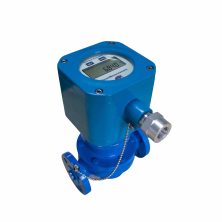
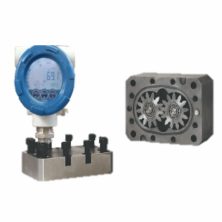
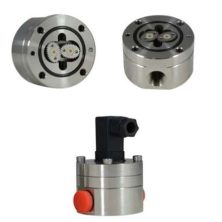
Positive Displacement Flow Meters Overview
Positive displacement flowmeters, or PD meters, feature two precisely machined intermeshing gears which rotate within a measuring chamber to determine the volumetric liquid flow rate by counting the number of the gears’ rotations. Positive displacement flow meters function in much the same manner as a positive displacement pump with the exception being that in the Positive Displacement pump the gears drive the fluid media, whereas in the PD flowmeter the fluid media drives the gears. The positive displacement meter technique is one of the oldest flow measurement technologies in existence and has been in use for over one hundred years. During that time, many different varieties of the PD meter have been developed including versions that feature round gears, oval gears, lobe gears, helical gears and nutating disc rotating elements. These meters are all characterized by high accuracy (up to ±0.1% of reading), good repeatability (up to 0.05% of reading), wide turndown ratios of up to 100:1, and the ability to maintain this level of performance for both high viscosity and changing-viscosity fluid media.
Why Choose a PD Flow Meter?
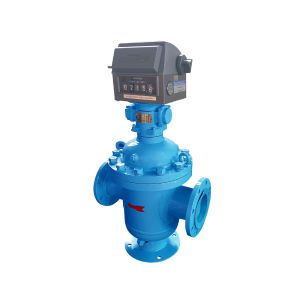
One common reason for using the positive displacement flow meter is that it can function without power. By outfitting the meter with a mechanical register, totalized flows may be accurately monitored in virtually any engineering unit desired by the end-user without the need to run power to the meter. This is ideal for applications where the meter must be installed in a remote location where power is not available. Positive displacement flow meters are available in sizes from ⅛” to 12 inches or more. Operation turndowns can be as high as 100:1, although ranges of 15:1 or lower are much more common. Slippage between the flowmeter components is reduced and metering accuracy is therefore increased as the viscosity of the process fluid flow increases. Therefore, positive displacement flow meters are excellent for highly viscous fluids such as oils and fats.
Most flowmeters are sensitive to turbulence, which means that a certain amount of straight, rigid pipe must be installed both upstream and downstream of the meter in order to reduce turbulence and accurately measure flow (Download PDF). Positive Displacement meters do not have this requirement. If necessary, an elbow or reducer bushing may be placed directly at the meter inlet with no impact on the meter’s accuracy.
Advantages of Using PD Flow Meters
Positive Displacement Flow meters being one of the oldest, if not the oldest flow meter technique, come in many different styles. The most popular ones are described on our Positive Displacement Measuring Principle page.
SmartMeasurement offers a range of positive displacement meters including the most popular styles of PD flowmeters in service today which include oval/lobe gear type, bi-rotor or helix gear types, and oval gear pd meters.
Although slippage through the positive displacement flow meters decreases (that is, accuracy increases) as fluid flow viscosity increases, pressure drop through the meter also rises. Consequently, the maximum (and minimum) flow capacity of the flowmeter is decreased as viscosity increases. The higher the viscosity, the less slippage and the lower the measurable flow rate. As the viscosity decreases, the low-flow performance of the meter deteriorates. The maximum allowable pressure drop across the meter constrains the maximum operating flow in high-viscosity services.
Features of Positive Displacement Flow Meters
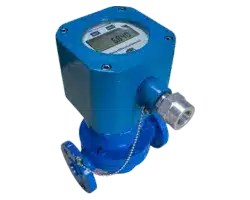
Positive Displacement (PD) Flow Meters are engineered with a unique set of features that make them highly effective for precise liquid flow measurement. One of the most significant features is exceptional accuracy. PD flow meters can measure the flow of liquids with precision, even in low-flow conditions, making them ideal for applications where exact measurements are crucial.
Another key feature is their ability to handle a wide range of viscosities. Whether the liquid is thin like water or thick like syrup, PD flow meters can maintain accurate readings without being affected by the fluid’s consistency. This versatility ensures they are suitable for various industries, including oil and gas, chemical processing, and food and beverage manufacturing.
PD flow meters are also known for their durability and reliability. Constructed from robust materials, these meters can withstand harsh environments and continuous operation without compromising performance. This durability translates into longer service life and reduced maintenance costs.
In addition, PD flow meters offer direct volumetric measurement, which eliminates the need for complex calculations or compensations. The mechanical operation of these meters ensures that every rotation or displacement corresponds to a specific volume, providing straightforward and reliable data.
Lastly, PD flow meters are designed with ease of installation and use in mind. Their simple mechanical design means they can be installed in various orientations without losing accuracy, and they require minimal upkeep, making them a cost-effective choice for many businesses.
Key Applications
Positive displacement flow meters flow meters from SmartMeasurement have been successfully installed in a wide variety of industries and applications including:
Oil & Gas
In the oil and gas industry, Positive Displacement (PD) Flow Meters are essential for accurately measuring the flow of crude oil, refined products, and natural gas liquids. Their ability to handle a wide range of viscosities makes them ideal for applications such as custody transfer, where precise measurement is critical to ensure fair trade and compliance with industry regulations.
Chemical & Petrochemical
PD flow meters are extensively used in the chemical and petrochemical industries due to their capability to accurately measure highly viscous and corrosive fluids. These meters are vital for monitoring and controlling the flow of various chemicals during processing, ensuring that production remains consistent and safe. Their robust design allows them to operate effectively in harsh environments, maintaining accuracy even with challenging liquids.
Fiscal Metering
In fiscal metering, where financial transactions are directly tied to the volume of liquid measured, PD flow meters play a crucial role. They provide the high precision required for billing purposes in industries like oil and gas, ensuring that the volume of product exchanged is measured accurately, minimizing disputes, and ensuring compliance with legal standards.
Fuel Transportation
For fuel transportation, PD flow meters are indispensable in measuring the volume of fuel transferred from one point to another, such as from a tanker to storage or from storage to a vehicle. Their reliability and accuracy ensure that every drop is accounted for, making them a trusted tool in the logistics of fuel distribution.
Liquid Storage Tanks
PD flow meters are often installed in liquid storage tanks to monitor the inflow and outflow of liquids. This application is particularly common in industries where precise inventory management is essential, such as in oil refineries or chemical plants. Their ability to measure large volumes accurately over extended periods ensures that storage levels are correctly tracked and maintained.
Food & Beverage
In the food and beverage industry, PD flow meters are used to measure ingredients, control mixing processes, and ensure consistent product quality. Their ability to handle various liquid viscosities, from water to syrups, makes them versatile for applications such as dairy processing, brewing, and bottling, where precision and hygiene are paramount.
Pharmaceutical
Pharmaceutical applications require the highest levels of accuracy and consistency, which is why PD flow meters are often used in the production of liquid medicines, vaccines, and other pharmaceutical products. Their ability to deliver precise measurements of active ingredients and solvents ensures that products meet strict quality and safety standards.
Marine & Shipping
In the marine and shipping industries, PD flow meters are crucial for monitoring the fuel consumption of ships and ensuring the accurate transfer of fuel and other liquids between vessels and storage facilities. Their robust design allows them to withstand the harsh conditions of marine environments while providing reliable and accurate measurements.
Theories of Flow Meter Operation

The oval gear positive displacement flow meters uses two fine-toothed gears, one mounted horizontally, the other vertically, with gears meshing at the tip of the vertical gear and the center of the horizontal gear, as shown in the illustration below. The two rotors rotate opposite to each other, creating an entrapment in the crescent-shaped gap between the housing and the gear. Oval gear flow meters can be very accurate if slippage between the housing and the gears is kept small. If the process fluid viscosity is greater than 10 cP and the flowrate is above 20% of rated capacity, accuracy of 0.1% of reading can be reached. At lower flows and at lower viscosities, slippage increases and accuracy decreases to 0.5% of reading or less.
As with other styles of positive displacement flowmeter, when an oval gear meter is being used, the lubricating properties of the fluid media can have an impact on the maximum turndown ratio that the meter is able to achieve. If a given liquid does not have good lubricating properties, the maximum rotor speed must be derated to prevent or limit wear. Alternatively, wear can be limited by maintaining pressure drops across the meter body that are less than 15 psi (< 0.1bar). If this method is used, the pressure drop across the meter will also limit the maximum possible flow for high viscosity liquids.
Variations of the oval gear positive displacement flow meters include the rotating lobe and impeller-type pd flow meters. One key distinction between these meters and the oval gear meter is that they do not share the precise gearing of the oval gear PD. A lobe-type PD meter contains two impellers that rotate in opposite directions of one another inside of the meter housing. As the lobes rotate, a known fixed volume of liquid is simultaneously allowed into and forced out of the meter housing. Because the lobe gears remain in a fixed relative position, it is only necessary to measure the rotational velocity of one gear. The lobe is either geared to a register or it is magnetically coupled to a pulse counting electronic device such as a reed switch or a Hall Effect. Lobe meters are available for line sizes ranging from 2″ to 24″. Effective flow measuring rages can be from 8-10 GPM up to 18,000 GPM for larger sized meters. However, bi-rotor or Helix gear positive displacement meters such as SmartMeasurement’ s ALBRPD are far better both in terms of accuracy and flow range.
The lobe gear meter is available in a wide range of materials of construction, from thermoplastics to highly corrosion-resistant metals. Disadvantages of this design include a loss of accuracy at low flows. Also, the maximum flow through this meter is less than that of the same sized oscillatory piston or nutating disc meters.
In these units, the passage of magnets embedded in the lobes of the rotating impellers is sensed by proximity switches (usually Hall-effect type) mounted external to the flow chamber. The sensor transmits a pulse train to a counter or flow controller. These meters are available in ¹⁄₁₀” to 6″ sizes but as mentioned above, they are declining in popularity. Today, oval gear meters are replacing lobe gear and impeller type positive displacement flow meters due to their superior accuracy and range-ability.

The helix meter is a positive displacement device that uses two radially pitched helical gears (see diagram below) to continuously entrap the process fluid as it flows. The flow forces the helical gears to rotate in the plane of the pipeline. Optical or magnetic sensors are used to encode a pulse train proportional to the rotational speed of the helical gears. The forces required to make the helices rotate are relatively small and therefore, in comparison to other PD meters, the pressure drop is relatively low. The best attainable accuracy is about ±0.1% or rate.
As shown in below, measurement error rises as either the operating flowrate or the viscosity of the process fluid drops. Bi-rotor meters such as SmartMeasurement’ s ALBRPD can measure the flow of highly viscous fluids (from 3 to 300,000 cP), making them ideal for extremely thick fluids such as glues and very viscous polymers. Because at maximum flow the pressure drop through the meter should not exceed 30 psid, the maximum rated flow through the meter is reduced as the fluid viscosity increases. If the process fluid has good lubricating characteristics, the meter turndown can be as high as 100:1, but lower (10:1) turndowns are more typical.
Bi-rotor meters are the PD meter of choice for fuel oils, fuel trucks, and crude oil monitoring. The high price and volatility of fuel prices makes the bi-rotor PD meter the instrument of choice because its highly accurate, can operate without external power and is excellent in confined spaces where there is no straight piping run or very limited straight runs available. See our pdf for more information. This style of meter is very popular for custody transfer applications. Shipping vessels are often times months out of port where fuel prices can change, therefore excess fuel when coming to port is sold in a custody transfer situation and a meter like this is used for the transaction.

PD meters must be used with clean fluids as well as fluids where there are no gas or air present. Particles greater than 100 microns in size must be removed by filtering. However, strainers or filters such as SmartMeasurement ALPDFT can eliminate any particles from the fluid before it reaches the PD meter.
Accuracies are not affected by pulsating flow unless it entrains air or gas in the fluid. The PD meter can still accommodate pulsating flows in the event of entrained air occurring by making use of an air/gas eliminator such as the SmartMeasurement ALPDGE or the ALPDFTG which adds a filter element. These devices are installed upstream of the meter to knock out gases before the liquid can be measured. Due to the tight clearances inside of the PD meter’s measuring chamber and between the intermeshing gears, it is important for the media to be clean as high particle counts or large particle sizes can cause the meter to seize. For applications such as well output monitoring in the Oil & Gas Industry where there may be particles such as sand or rocks entrained in the fluid, the ALPDFTG is the best option.

.
